 Religion
Guides
Language
EnglishCurrency
US dollar · $Prices on GetYourGuide appear in your chosen currency.
Guide · History
My Son Sanctuary history: the Champa kingdom and its holy valley
For about a thousand years the kings of Champa built and rebuilt brick towers for Shiva in one closed valley. This is the story the ruins tell, from the first wooden temple to the bombs.
Check availabilityfrom $16 · cancel without a fee
Editorial team, mysonsanctuarytour.comUpdated October 24, 2026Reading time about 6 minutes62 sources
The story in brief
- 01Who built it
- The Cham, whose kingdom of Champa lasted from the 2nd to the 17th century.1
- 02When
- From the 4th to the 13th century, over nine centuries.2
- 03For whom
- Hindu gods such as Krishna and Vishnu, above all Shiva.3
- 04What remains
- 71 standing monuments in eight groups, says UNESCO.4
- 05World Heritage
- Inscribed in 1999 for cultural interchange and Champa history.5
A closed valley chosen for the gods
My Son Sanctuary history begins with a choice of place. In the 4th century, under King Bhadravarman, the My Son valley was chosen as the holy city and religious centre of the Champa kingdom, according to the site's management board.6 The valley is about 2 km across and shut in by high mountains.7
The setting carried meaning. The sacred peak above it, Mahaparvata, rises 730 m and is already named in the first inscription found at My Son, from the 4th century.8 The river below, the Thu Bon, was called Mahanadi in Cham inscriptions and stood for the goddess Ganga, wife of Shiva.9 Mountain and river made the valley a model of the sacred world in miniature.
UNESCO describes the site as the religious and political capital of the Champa Kingdom for most of its existence, set in an elevated basin ringed by mountains.1011 Kings built their temples here, while power and trade lived elsewhere, in a royal capital at Tra Kieu and a port at the river mouth.12
Timeline
Kings, fire and rebuilding in one valley
-
4th century
The valley is chosen
Under King Bhadravarman My Son becomes Champa's holy city.6
-
529 to 577
The first temple burns
The wooden temple of Bhadresvara is lost to fire.13
-
7th century
Sambhuvarman rebuilds
His inscription is where the name Champa appears.14
-
10th century
A new face
Shaivism revives and many new towers are built.15
-
1234
The last royal builder
Jaya Paramesvaravarman II restores My Son for the last time.16
-
20th century
Rediscovery and war
French scholars study and conserve it; later wars damage many towers.1718
Who the Cham were
Champa was a kingdom of the Cham people, stretching over the central and southern coast of present-day Vietnam from the 2nd to the 17th century, according to Encyclopaedia Britannica.1 It was decentralised, made up of four small states: Amaravati around Quang Nam, Vijaya around Binh Dinh, Kauthara around Nha Trang and Panduranga around Phan Rang.19 My Son lies in Amaravati, the northern heartland.
UNESCO traces the kingdom to the ruling Dua clan, which united the Cham clans and founded the kingdom of Champapura in 192 CE.20 Britannica dates its first union under one king to about 400 CE, under Bhadravarman, the same ruler the site's board credits with choosing the valley.216
The culture that grew up here was shaped by India. UNESCO speaks of a culture whose spiritual origins lay in Indian Hinduism, developing on the coast between the 4th and 13th centuries.22 Britannica adds that Cham sculptors, influenced by Indian Gupta art, developed a personal style of forms springing with wild energy, while their architecture was mostly tiered brick towers.23
In figures
My Son Sanctuary facts in figures
| What | Figure | Source |
|---|---|---|
| Standing monuments | 71 in eight groups | UNESCO |
| Temple structures | More than 70 | Site's board |
| World Heritage property | 142 ha | UNESCO |
| Buffer zone | 920 ha | UNESCO |
| Valley width | About 2 km | Site's board |
| Sacred peak | 730 m | Site's board |
| Gold and silver on the roofs | 1,470 kg | Boisselier, 1963 |
| Inscribed | 4 December 1999 | Site's board |
Figures as each source gives them; UNESCO counts standing monuments, the board counts structures.425782425
Decision helper
How deep do you want to go?
Choose how much history you want on the day
The My Son Museum
It stands about 2 km north-west of the monuments, by the Khe The stream.26
A guided trip
Our pick gives about two hours at the towers with an English guide.
The board's guided route
The site's standard guided route takes about 60 minutes.27
Add Da Nang's museum
The tourism authority recommends the Museum of Cham Sculpture in Da Nang.28
An afternoon trip
Its option includes a Cham performance at the site.
Kazik (Kazimierz Kwiatkowski), the architect who spent many years at My Son, exclaimed: the ancient Cham entrusted their spirit to earth and stone, and knew how to rely on nature to create a My Son that is splendid, solemn and majestic.
Shiva and the god-kings
The first temple at My Son was built of wood for the god-king Bhadresvara, a name that joins Isvara, meaning Shiva, with that of King Bhadravarman.30 It set the pattern for the whole site, where the king and the god were honoured under one name.
That first wooden temple burned down at some time between 529 and 577.13 In the 7th century King Sambhuvarman restored it, and his inscription is where the name Champa appears.14 Later rulers kept building: Prakasadharma, crowned in 653, raised many temples at My Son.31
Hindu gods such as Krishna and Vishnu had temples too, but Shiva above all.3 Mahayana Buddhism reached Cham culture, probably from the 4th century, and took hold in the north of the kingdom, yet Shivite Hinduism remained the state religion.32 UNESCO reads the towers as images of Mount Meru, the sacred mountain home of the Hindu gods, rebuilt in the mountainous Cham homeland.33
Map
From the coast at Hoi An to the temple groups of My Son
First the drive inland from Hoi An and Da Nang airport, then the valley itself, where the tower groups stand a short walk apart.
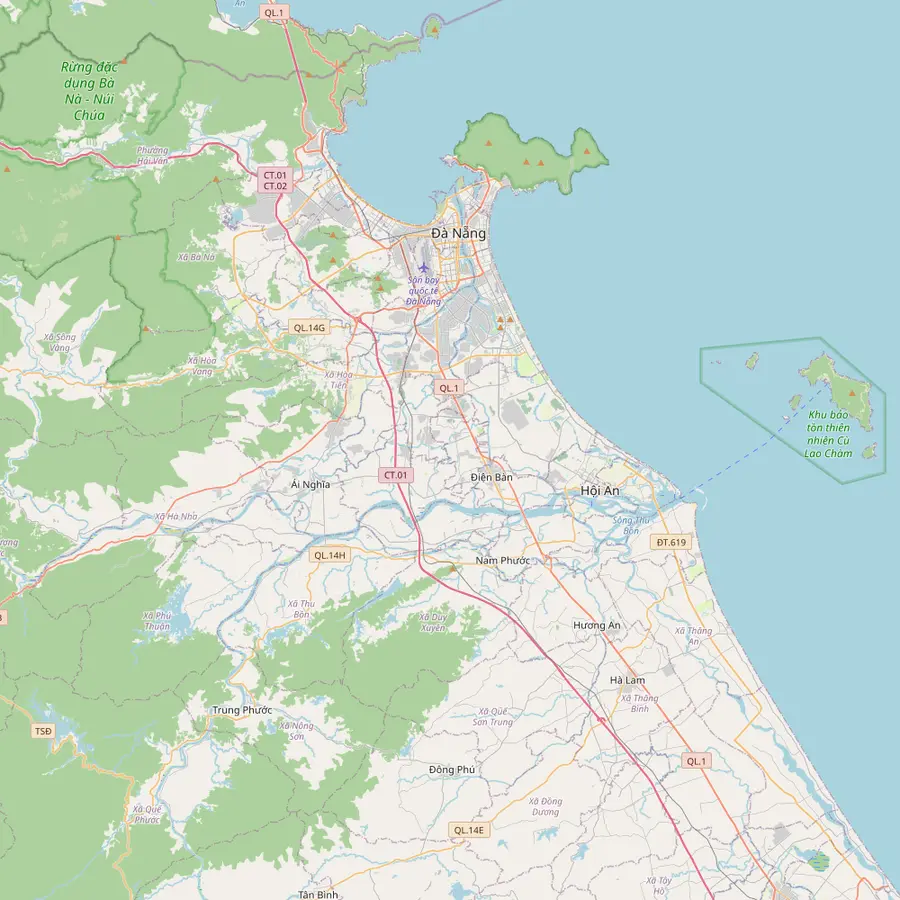 1Hoi An Ancient Town2Da Nang airport3My Son Sanctuary
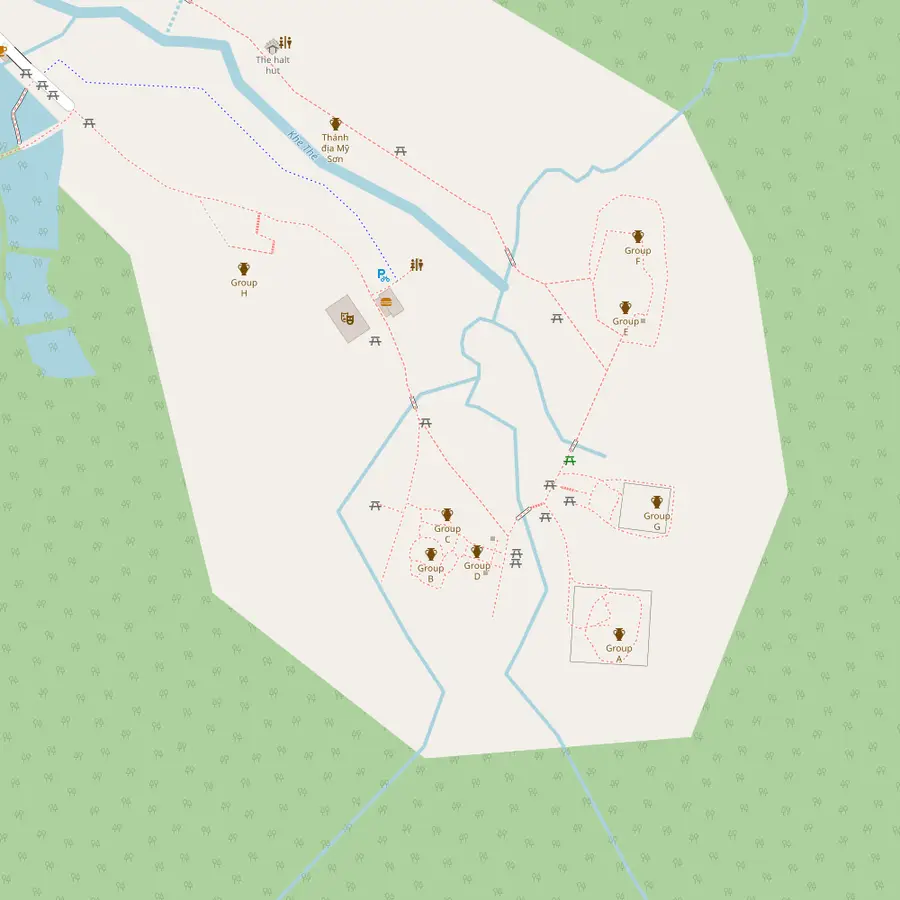 4Groups B, C and D5Group G6Group H7Groups E and F8Group A
- 1Hoi An Ancient Town
A small trading port of the 15th to 19th centuries near the mouth of the Thu Bon, on the World Heritage List since 1999.343536
In Google Maps ↗ - 2Da Nang airport
About 29 km from Hoi An Ancient Town; shuttle vans to Hoi An leave hourly from 5am to 11pm.3738
In Google Maps ↗ - 3My Son Sanctuary
Open every day from 06:00 to 17:00; the site's board puts it 45 km from Hoi An and 68 km from Da Nang.3940
In Google Maps ↗ - 4Groups B, C and D
The tower groups where the show "Echoes of My Son" is staged on the 15th of every month.41
In Google Maps ↗ - 5Group G
A performance is held here at 9:00 and again at 14:45.42
In Google Maps ↗ - 6Group H
Cham folk singing on the slope below the group every Monday, Wednesday and Friday.43
In Google Maps ↗ - 7Groups E and F
Tower E1 gives its name to the ancient style, the first in the line of building styles found at My Son.44
In Google Maps ↗ - 8Group A
Group A lends its name to the My Son A1 style, one of the later styles in the sanctuary's sequence.44
In Google Maps ↗
Checklist
What to look for at the towers
01
In each group
- The main shrine, the kalan, at the centre
- The gate tower in front of it
- Main doors facing east
02
In the details
- Sandstone reliefs of Hindu myths
- Carved brick on the tower walls
- Scars left by the wars
Cost calculator
Price a guided visit for your group
Enter your group size to compare a guided trip with going on your own.
People
Total from$32
each from $16
Check availabilityfree cancellationEach total multiplies a listing's lowest GetYourGuide starting price by your party size and shows it in your currency at today's ECB rate; the entrance ticket at My Son is paid on top, and checkout gives the exact sum.
Video
Living relics of the Champa kingdom
Until you tap play, the video stays unloaded.
Nine centuries of building, with gaps
The site was not built in one burst. Between 749 and 875 power passed to a clan in the south, which built its own sanctuary at Po Nagar, and My Son received less attention.45 At the end of the 9th century Buddhism became the state religion; King Indravarman II moved the capital back to Quang Nam and built the Buddhist monastery of Dong Duong.46
In the early 10th century Shaivism revived, old towers were repaired and many new ones were built, giving the sanctuary a new face.15 One later king, Indravarman IV, offered gold and silver to cover the temple roofs; the precious metal used reached 1,470 kg, according to a 1963 study by the scholar Boisselier.24 In 1234 King Jaya Paramesvaravarman II was the last to restore My Son, and later records no longer mention it.16
Wars shaped those centuries. Britannica records that Dai Viet forced Champa to give up Amaravati in 1000 and Vijaya in 1069, that the Khmers conquered Champa in 1145, and that a Cham king sacked Angkor in 1177.4748 Province by province the kingdom was annexed until it was absorbed entirely in the 17th century.49
How the towers were built
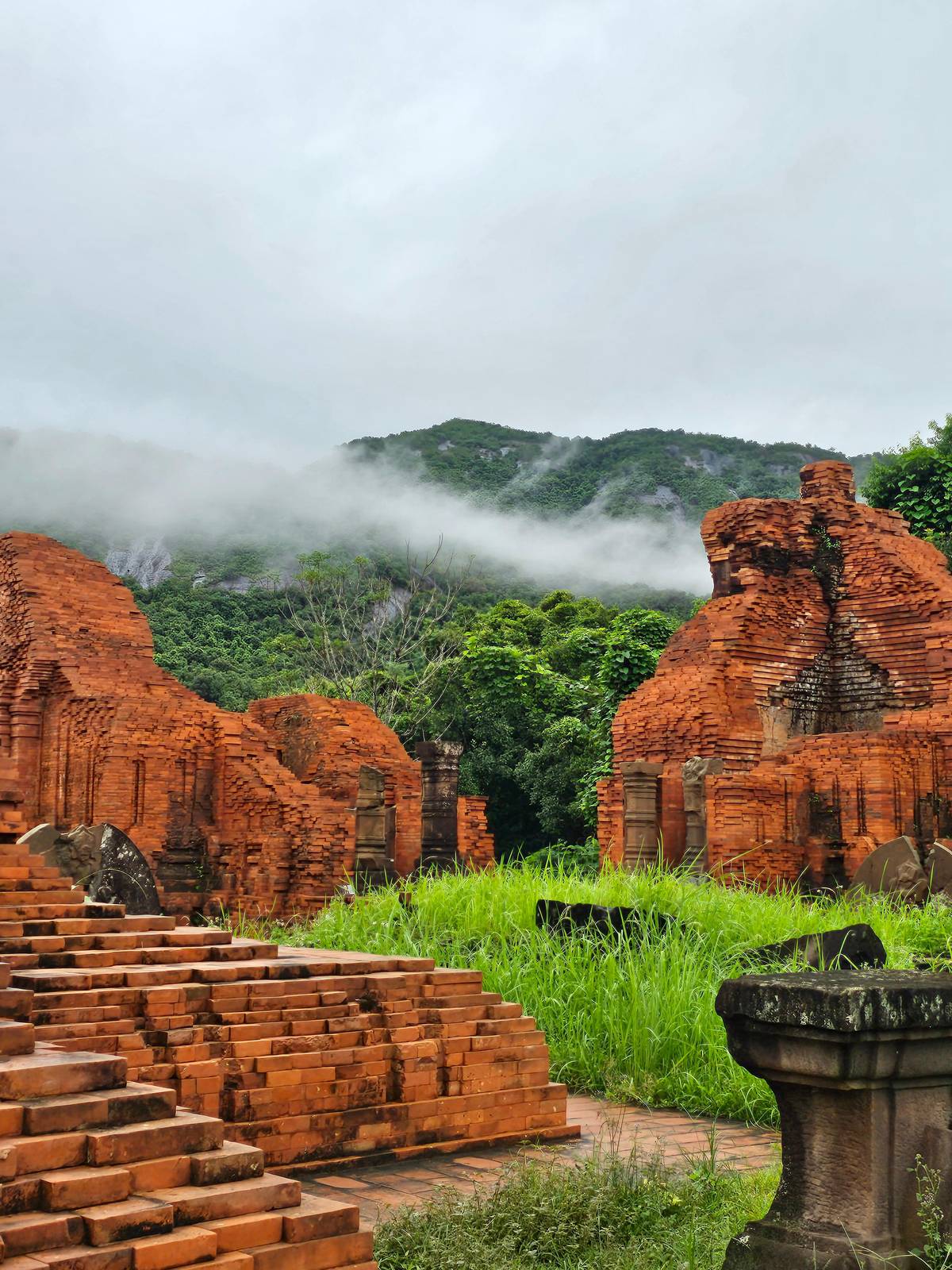
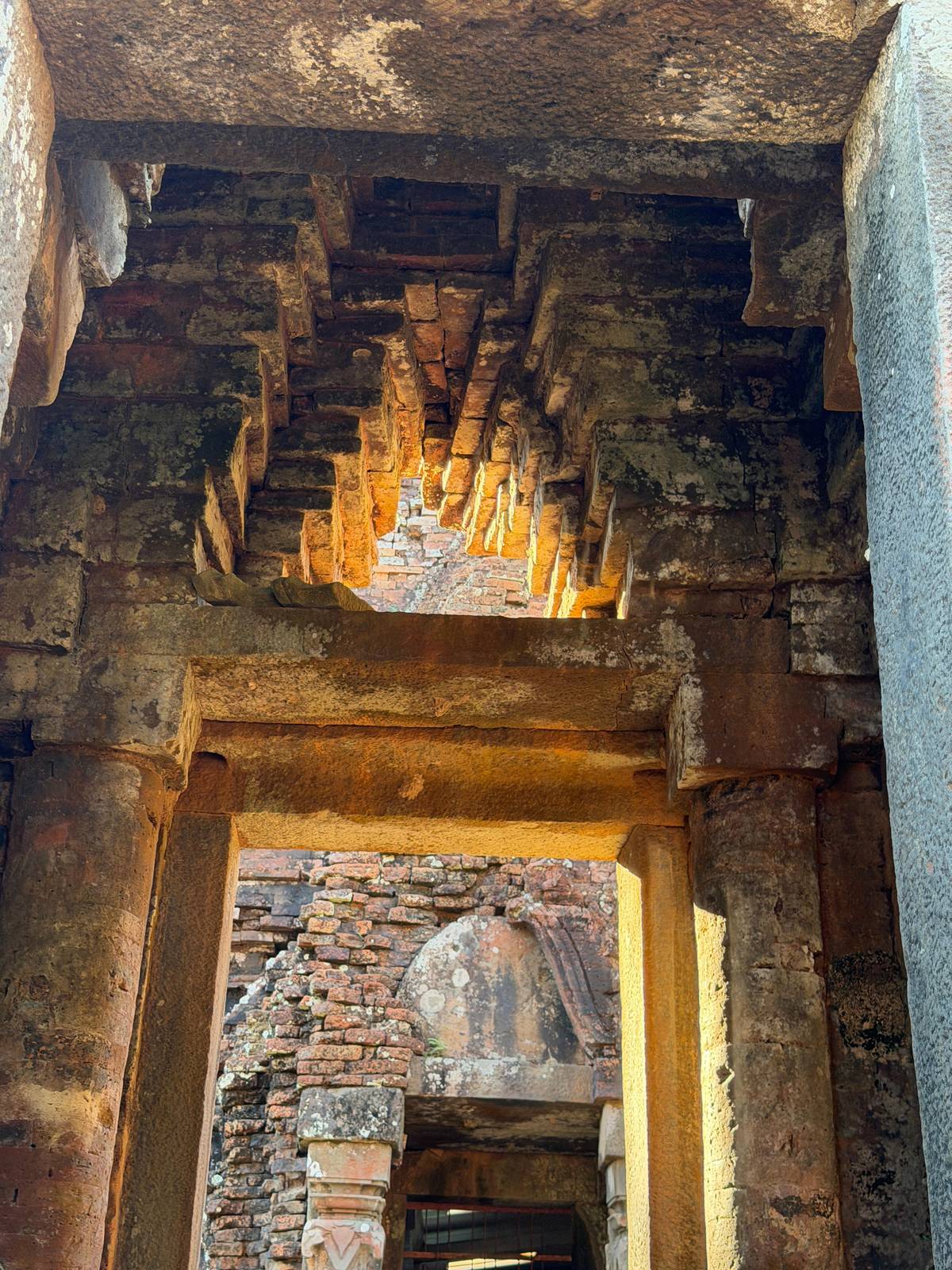
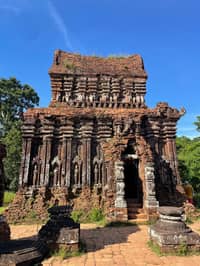
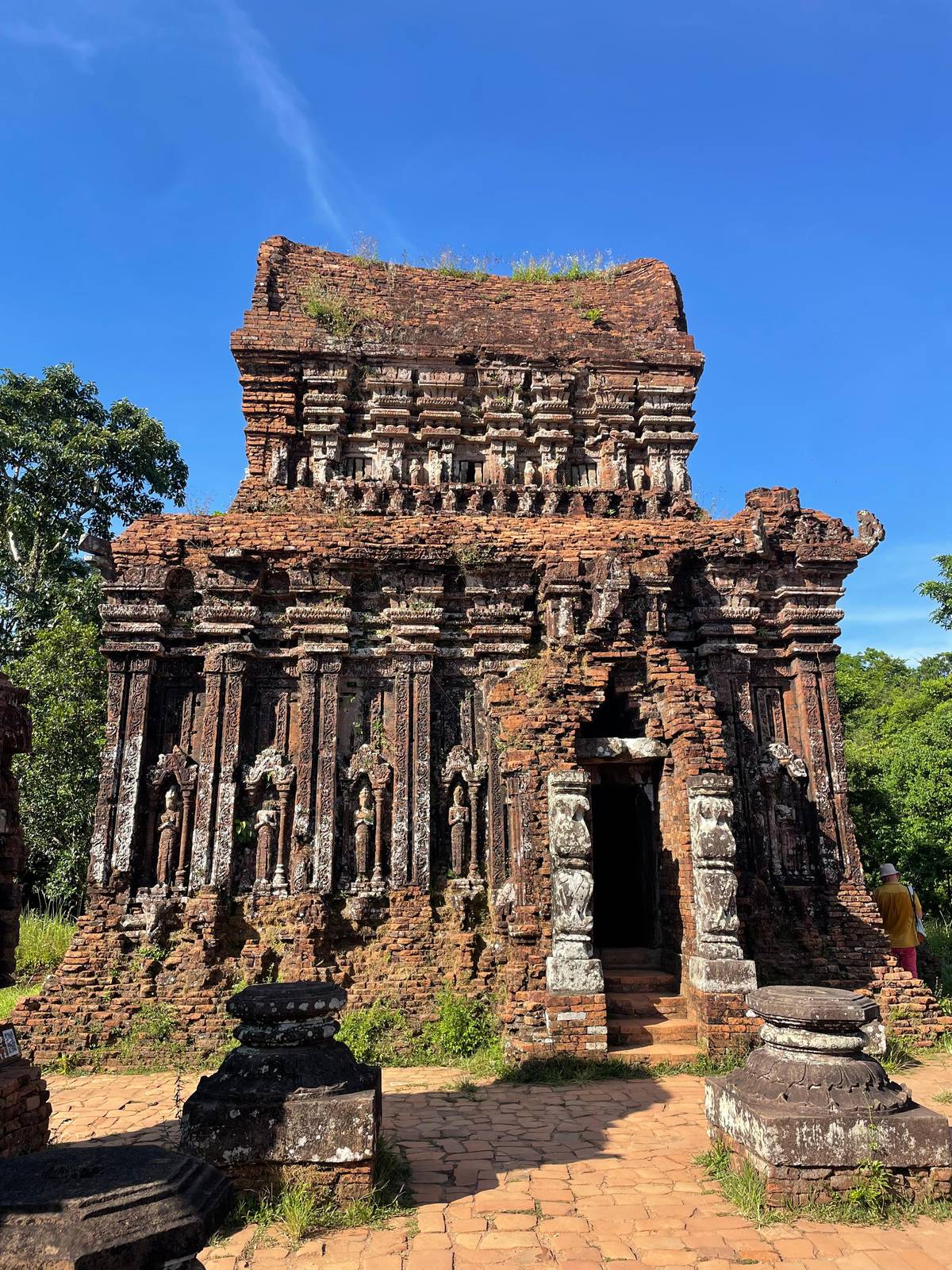
UNESCO describes the towers as fired brick with stone pillars, decorated with sandstone bas-reliefs of scenes from Hindu mythology, and calls them masterpieces of brick construction for both their building technique and their carved-brick decoration.5051 The national tourism authority adds that the bricks were held together without mortar or holes and have lasted to this day.52
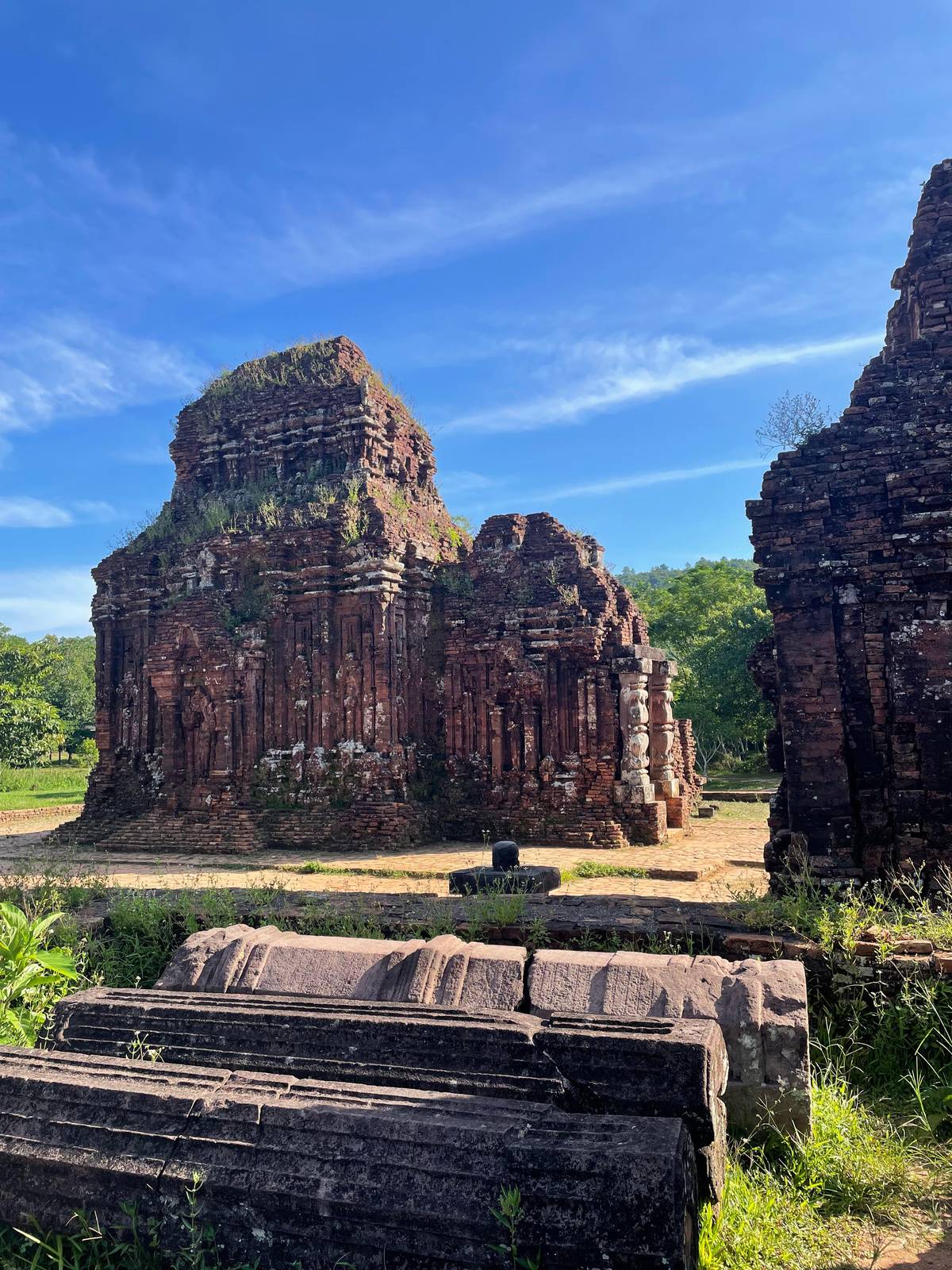
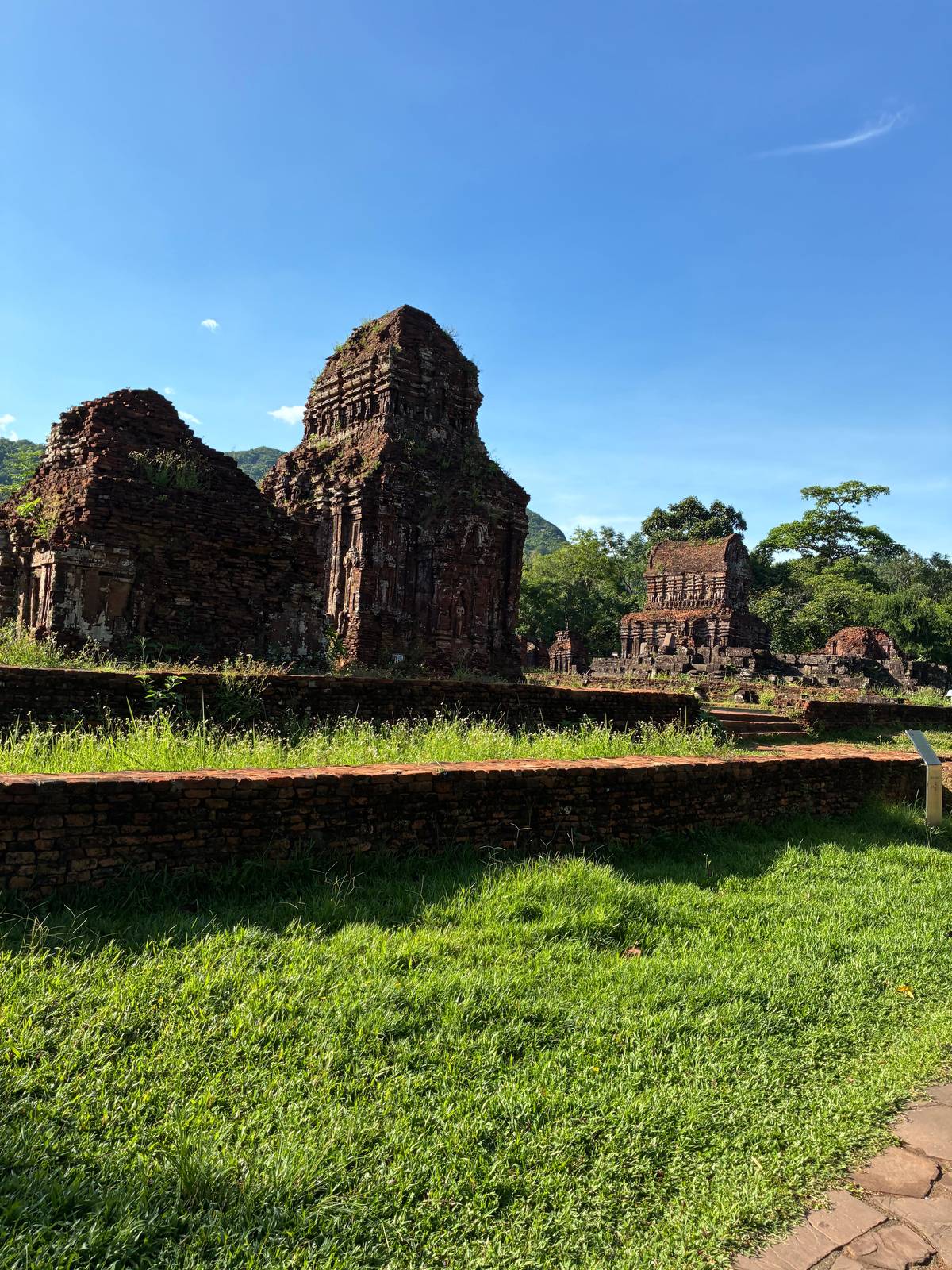
Each group follows a plan. In front of the main temple, the kalan, stands a gate tower, the gopura, and beside it usually a long tiled hall, the mandapa, where pilgrims gathered, offerings were received and ritual dances were held.53 The main door of the main tower mostly faces east, towards the gods.54 Smaller temples and outbuildings surround the main shrine.
The board counts the styles found here, from the ancient style of tower E1 through Hoa Lai, Dong Duong and My Son A1 to the later Po Nagar and Binh Dinh styles.44 It says no other site in the region shows continuous development over almost nine centuries, and UNESCO calls the monuments unique and without equal in Southeast Asia.5556
My Son Sanctuary before the war, and after
After the last royal restoration the valley falls silent in the records.16 Modern conservation began in the early 20th century, soon after French archaeologists brought the monuments back to light, and our knowledge of the site still rests on the work of Henri Parmentier from that period.1757 What My Son Sanctuary looked like before the war is known largely through those early surveys.
Then came the damage. UNESCO records that many tower temples were damaged during World War II, the First Indochina War and, above all, the Second Indochina War.18 Since 1975 the authorities have cleared unexploded ordnance at four main monuments, but the work is slow and much remains, and possible ordnance in the buffer zone has held back research, restoration and the presentation of the site.5859
Restoration has been careful. UNESCO describes conservation under French and Polish expert guidance as relatively minor, which helps keep the site authentic.60 The architect Kazimierz Kwiatkowski, known as Kazik, worked at My Son for many years.29 Viet Nam recognised it as a National Site in 1979 and as a Special National Site in 2009.61
World Heritage, and seeing the story today
My Son was inscribed on the UNESCO World Heritage List on 4 December 1999, at the committee's meeting in Marrakesh.25 The property covers 142 ha with a buffer zone of 920 ha.5 UNESCO calls it an exceptional example of cultural interchange, an indigenous society adapting outside influences, above all the Hindu art and architecture of the Indian subcontinent.62
To read the ruins well, start with context. The My Son Museum stands about 2 km north-west of the monuments; it was built in 2004 and 2005 with a grant from the Japanese government.26 For the finest sculpture, the national tourism authority points to the Museum of Cham Sculpture in Da Nang.28
On site, a guide makes the difference between a walk among red ruins and an understanding of what you are looking at. The board's own guided route takes about 60 minutes, while the trip this site recommends gives you about two hours at the towers with an English-speaking guide.27
Your morning
The Cham towers at dawn, back by eleven.
Hotel pickup in Hoi An, a guide, coffee and a Champa brunch; cancel free up to 24 hours before.


You ask,we answer.
Who built the towers at My Son Sanctuary?
The kings of Champa. The Cham kingdom of Champa lasted from the 2nd to the 17th century on the coast of today's Vietnam.1
How old are the oldest buildings at My Son?
The site dates from the 4th century. The valley was chosen in the 4th century; the first temple was wooden and burned between 529 and 577.613
Which god was worshipped at My Son?
Shiva, above all. Temples were also built to Krishna and Vishnu, but Shiva came first.3
When was the last tower restored in Champa times?
In 1234. King Jaya Paramesvaravarman II was the last to restore My Son; later records are silent.16
Why are so many of the towers ruined?
Time, and war. Many were damaged in World War II and both Indochina Wars, above all the second.18
When did My Son become a World Heritage site?
On 4 December 1999. It was inscribed at the World Heritage Committee's meeting in Marrakesh.25
Where can I see Cham sculpture besides My Son?
In Da Nang. The tourism authority points to the Museum of Cham Sculpture in Da Nang.28
Sources
The sources for this guide
- 1Encyclopaedia BritannicaChampa (ancient kingdom, Indochina)↩
- 2My Son World Cultural Heritage Management Board (official site)Ve chung toi (About the site)↩
- 3UNESCO World Heritage CentreMy Son Sanctuary↩
- 4UNESCO World Heritage CentreMy Son Sanctuary↩
- 5UNESCO World Heritage CentreMy Son Sanctuary↩
- 6My Son World Cultural Heritage Management Board (official site)Lich su van hoa (History and culture)↩
- 7My Son World Cultural Heritage Management Board (official site)Lich su van hoa (History and culture)↩
- 8My Son World Cultural Heritage Management Board (official site)Canh quan khong gian (Landscape and setting)↩
- 9My Son World Cultural Heritage Management Board (official site)Canh quan khong gian (Landscape and setting)↩
- 10UNESCO World Heritage CentreMy Son Sanctuary↩
- 11UNESCO World Heritage CentreMy Son Sanctuary↩
- 12My Son World Cultural Heritage Management Board (official site)Canh quan khong gian (Landscape and setting)↩
- 13My Son World Cultural Heritage Management Board (official site)Lich su van hoa (History and culture)↩
- 14My Son World Cultural Heritage Management Board (official site)Lich su van hoa (History and culture)↩
- 15My Son World Cultural Heritage Management Board (official site)Lich su van hoa (History and culture)↩
- 16My Son World Cultural Heritage Management Board (official site)Lich su van hoa (History and culture)↩
- 17UNESCO World Heritage CentreMy Son Sanctuary↩
- 18UNESCO World Heritage CentreMy Son Sanctuary↩
- 19Encyclopaedia BritannicaChampa (ancient kingdom, Indochina)↩
- 20UNESCO World Heritage CentreMy Son Sanctuary↩
- 21Encyclopaedia BritannicaChampa (ancient kingdom, Indochina)↩
- 22UNESCO World Heritage CentreMy Son Sanctuary↩
- 23Encyclopaedia BritannicaChampa (ancient kingdom, Indochina)↩
- 24My Son World Cultural Heritage Management Board (official site)Lich su van hoa (History and culture)↩
- 25My Son World Cultural Heritage Management Board (official site)Ve chung toi (About the site)↩
- 26My Son World Cultural Heritage Management Board (official site)Bao tang My Son (My Son Museum)↩
- 27My Son World Cultural Heritage Management Board (official site)Quy dinh so luong khach/doan thuyet minh va so ve huong dan thuyet minh (Guided commentary rules, 20 January 2026)↩
- 28Viet Nam National Authority of Tourism (vietnam.travel)Explore the global cultural and historical values of My Son Sanctuary↩
- 29My Son World Cultural Heritage Management Board (official site)Ve chung toi (About the site)↩
- 30My Son World Cultural Heritage Management Board (official site)Lich su van hoa (History and culture)↩
- 31My Son World Cultural Heritage Management Board (official site)Lich su van hoa (History and culture)↩
- 32UNESCO World Heritage CentreMy Son Sanctuary↩
- 33UNESCO World Heritage CentreMy Son Sanctuary↩
- 34UNESCO World Heritage CentreHoi An Ancient Town↩
- 35UNESCO World Heritage CentreHoi An Ancient Town↩
- 36UNESCO World Heritage CentreHoi An Ancient Town↩
- 37Viet Nam National Authority of Tourism (vietnam.travel)A traveller's guide to Vietnam's airports↩
- 38Viet Nam National Authority of Tourism (vietnam.travel)A traveller's guide to Vietnam's airports↩
- 39My Son World Cultural Heritage Management Board (official site)Gio mo, dong cua va lich bieu dien van nghe (Opening hours and show schedule)↩
- 40My Son World Cultural Heritage Management Board (official site)Ve chung toi (About the site)↩
- 41My Son World Cultural Heritage Management Board (official site)Gio mo, dong cua va lich bieu dien van nghe (Opening hours and show schedule)↩
- 42My Son World Cultural Heritage Management Board (official site)Gio mo, dong cua va lich bieu dien van nghe (Opening hours and show schedule)↩
- 43My Son World Cultural Heritage Management Board (official site)Gio mo, dong cua va lich bieu dien van nghe (Opening hours and show schedule)↩
- 44My Son World Cultural Heritage Management Board (official site)Kien truc nghe thuat (Architecture and art)↩
- 45My Son World Cultural Heritage Management Board (official site)Lich su van hoa (History and culture)↩
- 46My Son World Cultural Heritage Management Board (official site)Lich su van hoa (History and culture)↩
- 47Encyclopaedia BritannicaChampa (ancient kingdom, Indochina)↩
- 48Encyclopaedia BritannicaChampa (ancient kingdom, Indochina)↩
- 49Encyclopaedia BritannicaChampa (ancient kingdom, Indochina)↩
- 50UNESCO World Heritage CentreMy Son Sanctuary↩
- 51UNESCO World Heritage CentreMy Son Sanctuary↩
- 52Viet Nam National Authority of Tourism (vietnam.travel)Explore the global cultural and historical values of My Son Sanctuary↩
- 53My Son World Cultural Heritage Management Board (official site)Kien truc nghe thuat (Architecture and art)↩
- 54My Son World Cultural Heritage Management Board (official site)Kien truc nghe thuat (Architecture and art)↩
- 55My Son World Cultural Heritage Management Board (official site)Kien truc nghe thuat (Architecture and art)↩
- 56UNESCO World Heritage CentreMy Son Sanctuary↩
- 57UNESCO World Heritage CentreMy Son Sanctuary↩
- 58UNESCO World Heritage CentreMy Son Sanctuary↩
- 59UNESCO World Heritage CentreMy Son Sanctuary↩
- 60UNESCO World Heritage CentreMy Son Sanctuary↩
- 61UNESCO World Heritage CentreMy Son Sanctuary↩
- 62UNESCO World Heritage CentreMy Son Sanctuary↩